
Insight
Taking art out of China: the wax seal is what customs actually looks for
A cultural relic leaves China against a three-part permit and a wax seal applied by the appraisal office. Carrying one out without declaring it is treated as smuggling, whether or not it was concealed.
- Published
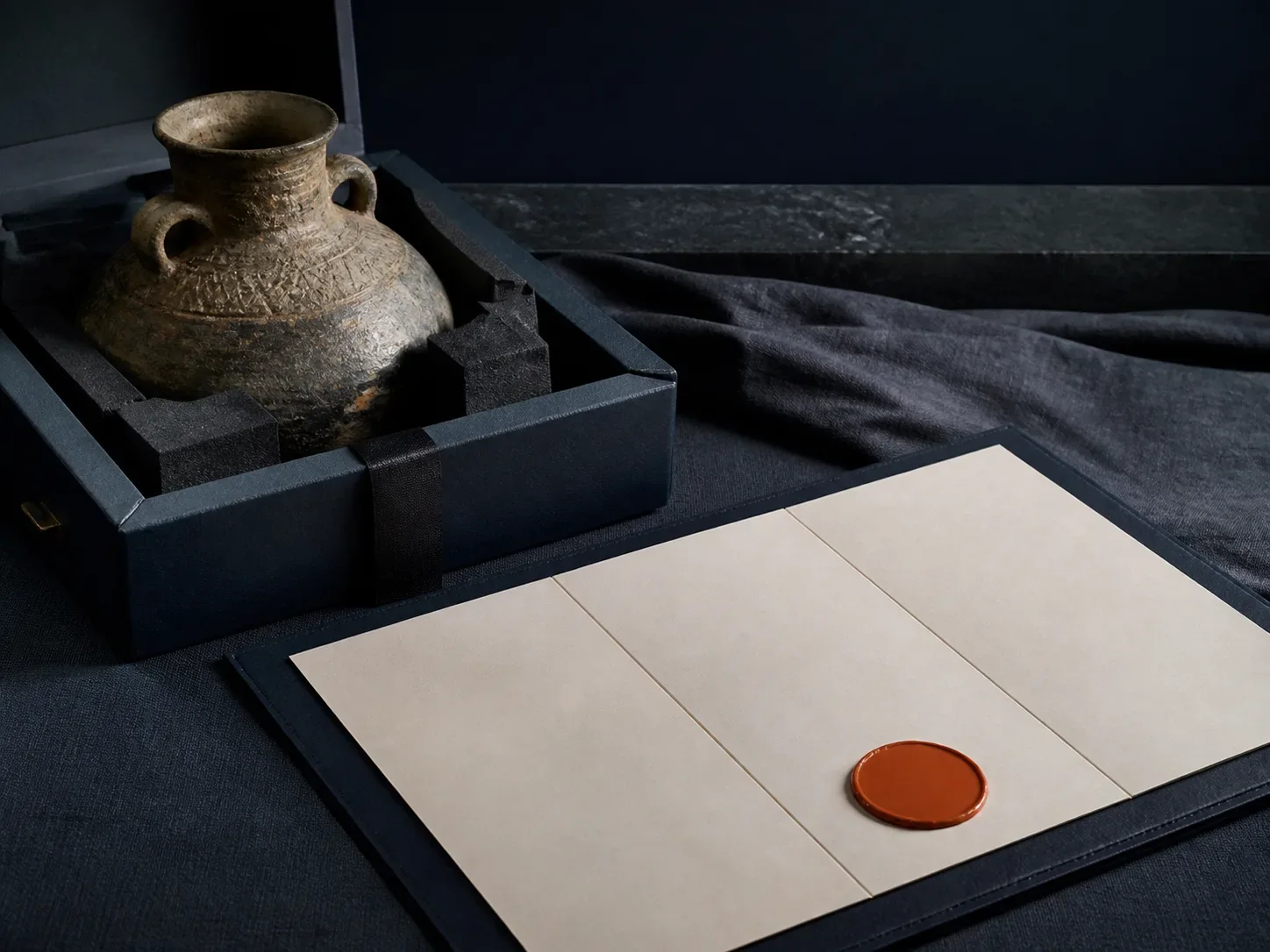
The export control on Chinese cultural relics is enforced through a physical mark rather than a database lookup, and knowing what that mark is explains most of how the process works.
Customs releases an outgoing cultural relic against two things: the three-part Cultural Relic Export Permit in its 2016 form, and a wax seal applied by the State Administration of Cultural Heritage’s import and export appraisal office — the 2009 pattern, with the Chinese character 出 in Song typeface set into the opening of the design. Reproductions leave against a reproduction certificate and an export mark of their own.
Three details on the permit are checked and are worth getting right before travel:
- It carries the appraisal office’s seal
- The photograph on the permit matches the physical object
- It is within its three-month validity
Fourteen national cultural relic appraisal offices across the country hold the authority to carry out this examination.
Not declaring is treated as smuggling
This is the part that catches private individuals and, occasionally, professional shippers who assume a low-value object is a low-risk one.
Carrying or posting cultural relics out of China — including works by deceased modern painters and calligraphers of note — requires an active declaration to customs. Where no declaration is made, the matter is handled as smuggling whether or not the object was concealed. Concealment is not the test; the absence of a declaration is.
Where a declaration is made but the permit and appraisal mark, or the invoice, cannot be produced, the outcome is much softer: export is refused and the object is returned. The owner has three months to collect it — one month for travellers moving between the mainland and Hong Kong or Macau — after which customs disposes of it under the law.
The distinction between those two outcomes is worth restating, because it is entirely within the shipper’s control. Declaring without the right documentation produces a refusal. Not declaring produces a smuggling case.
Temporary import, and getting the object out again
Objects brought in temporarily for restoration, exhibition, sale or auction, and intended to leave again afterwards, run on their own track. Thirteen designated appraisal stations handle them: Beijing, Tianjin, Hebei, Shanghai, Jiangsu, Zhejiang, Anhui, Fujian, Shandong, Henan, Hubei, Yunnan and Shaanxi.
Three failures push a temporarily imported object out of that track and into the ordinary export regime, where it needs a full export permit:
- It was not declared on entry
- The customs seal is found broken
- The re-export appraisal was not carried out as required
For an exhibition or auction consignment, the first and third are scheduling problems as much as documentary ones — the appraisal has to be built into the return timetable rather than arranged when the show closes.
Thresholds for goods carried in personally
Travellers’ baggage is limited to reasonable quantities for personal use, and declaration thresholds differ by residency:
- Resident travellers — declare articles acquired abroad with a total value over RMB 5,000
- Non-resident travellers — declare articles intended to remain in China with a total value over RMB 2,000
For personally posted artworks, value limits apply per shipment: RMB 800 to Hong Kong, Macau and Taiwan, and RMB 1,000 to other countries and regions. Above those, the options are return or clearance as ordinary cargo — with an exception where customs accepts that a single indivisible article is for personal use. Where the work falls under controlled fine art, the separate rules on fine art import and export apply.
What is not a cultural relic
Two clarifications that save unnecessary applications.
Decorative stone — chrysanthemum stone, picture stone — is not a national cultural relic. It exports as ordinary goods: engage a company with import and export rights, registered with customs, and declare with the contract, invoice, waybill, packing list and any regulatory certificates.
Modern jade bangles, figurines and similar objects may be carried out directly where they are genuinely not antiques. Where an object is old and its status is uncertain, the route is appraisal by the cultural heritage authority and a certificate, obtained before travel rather than at the airport.
How this fits a commercial consignment
For a gallery, auction house or collector moving work through China, the sequence is:
- Establish whether each object is a cultural relic.
- Obtain appraisal and permit for those that are.
- Keep the permit inside its three-month life, against the actual departure date.
- The wax seal must be intact when the object reaches the border.
For inbound work returning later, the two things that matter are the declaration on entry and the seal remaining unbroken — because both are conditions of the easier route out, and neither can be reconstructed afterwards.
Packing sits alongside this rather than after it. We keep an in-house packing team for exactly this category. Paintings are interleaved individually to protect the surface and wrapped against moisture, and fragile and sculptural pieces get made-to-shape support, so that the object arrives in the condition the appraisal recorded.