
Insight
Meat imports into China: three registrations, a 48-hour clock, and what goes on the carton
The destination on the outer packaging must read People’s Republic of China, the origin must go down to state or province, and the health certificate data has to reach customs 48 hours before the goods do.
- Published
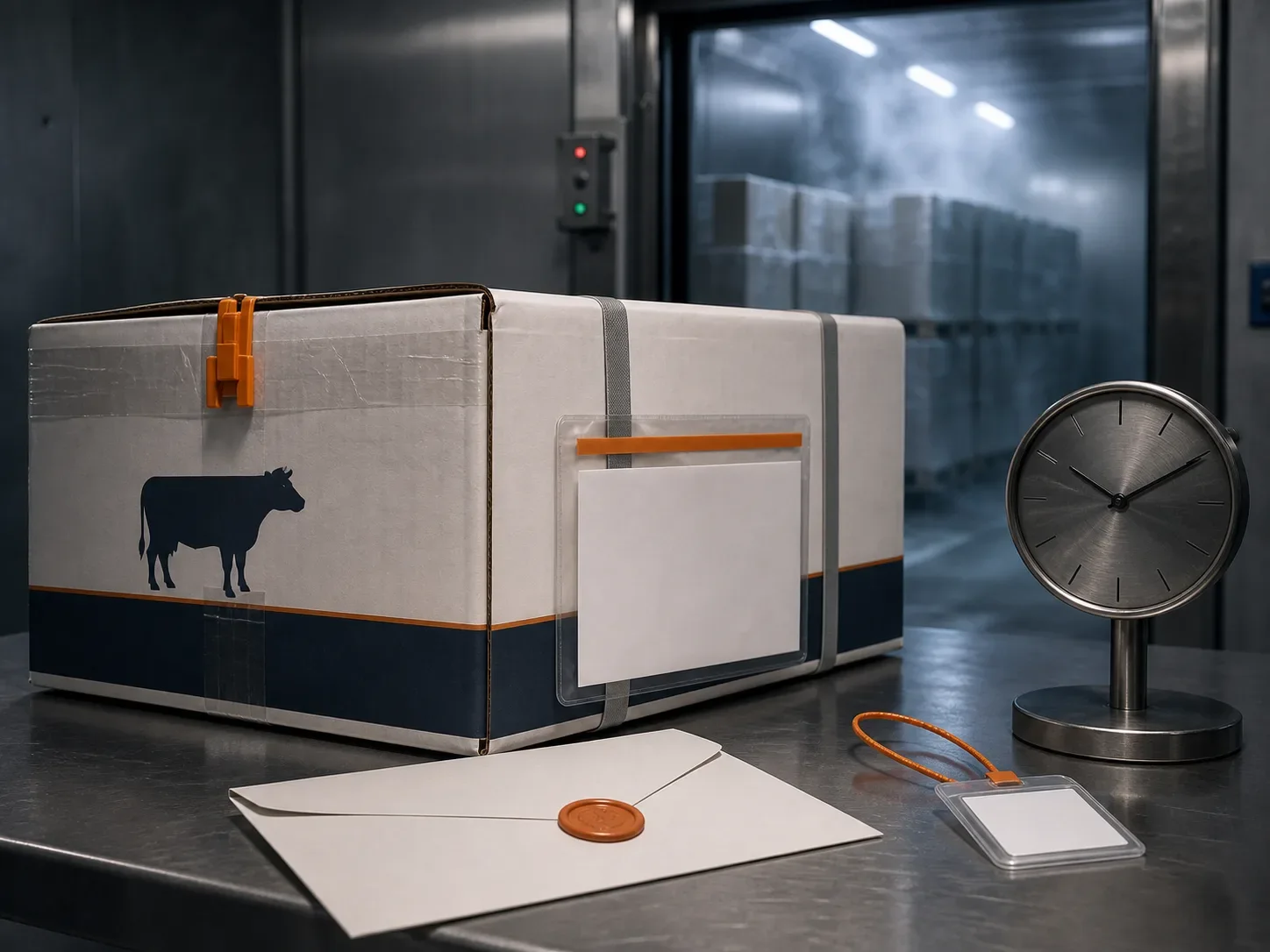
Meat is the food category with the most parties to get registered and the least room to recover from a mistake. Three separate companies need to be on file before a shipment is possible, the official health certificate has to reach customs electronically 48 hours ahead of the goods, and if the consignment fails inspection there is no technical-treatment route: the whole lot is returned or destroyed.
None of that is discoverable at the port. All of it is settled weeks earlier.
Regulatory basis
- 《中华人民共和国进出口食品安全管理办法》 — Administrative Measures on Import and Export Food Safety, GACC Order No. 249
- 《符合评估审查要求的国家或地区输华肉类产品名单》 — the list of countries and regions approved to export meat to China, published and updated by the GACC Import and Export Food Safety Bureau
- The bilateral protocol between China and the exporting country, where one exists
Access is by country, establishment and product together
Only meat from a country or region on the approved list, produced by an approved establishment, and of a specified meat product type, may be exported to China. All three have to line up. A country approved for beef is not thereby approved for pork; an approved country with an unapproved plant does not help; and an approved plant producing a product type outside its listing does not either.
The list is dynamic. It is worth checking against the current version rather than against a determination made for an earlier shipment.
Three registrations, held by three different parties
The overseas production establishment — slaughterhouse, cutting plant, processing facility and cold store — must be recommended to GACC by the competent authority of its own country and registered. This is not a self-service route; it runs through the exporting country’s government. Registration status is checkable on CIFER at ciferquery.singlewindow.cn.
The overseas exporter or agent files its own details in the GACC importer and exporter filing system for food and cosmetics at ire.customs.gov.cn.
The Chinese importer files in the same system, and cannot begin import formalities until that filing is complete.
Three parties, three separate actions, one of which depends on a foreign government’s timetable. That last point is what makes the establishment registration the critical path in most first-time meat projects.
Who applies for which document
| Applicant | Document | Notes |
|---|---|---|
| Chinese importer | Quarantine permit for entry animals and plants | Obtain via the Internet+Customs platform before the trade contract is signed |
| Chinese importer | Automatic import licence | Required for certain meats — bone-in frozen beef, fresh, chilled and frozen bone-in pork among them, identifiable by supervision code 7. Verified electronically at declaration |
| Overseas exporter | Certificate of origin | Evidences origin, and supports a preferential rate where an agreement applies |
| Overseas exporter | Official health certificate | Issued by the exporting country’s authority, sealed and signed, certifying conformity with Chinese law and the bilateral protocol |
The sequencing point in the first row is easy to miss: the quarantine permit is obtained before the contract is signed, not before the goods ship. Signing first and applying afterwards puts a commercial commitment ahead of a licence that may not arrive.
The 48-hour clock
The health certificate’s electronic data must be transmitted to Chinese customs through official channels at least 48 hours before arrival. Not with the goods, and not on arrival.
This is a coordination obligation on the exporting country’s authority rather than on the shipper, which is precisely why it fails: nobody in the commercial chain owns it. On a short sea leg or an air shipment, 48 hours can be most of the transit time, so the transmission has to be arranged when the certificate is issued rather than when the vessel is due.
What must be printed on the carton
Packaging for fresh and frozen meat carries durable, legible markings in Chinese and English, or Chinese and the exporting country’s language. The requirements differ between outer and inner packaging, and the two most commonly failed items are both about naming places precisely.
Outer packaging:
- Specification
- Place of origin, down to state, province or city — the country alone is not enough
- Destination, stated as the People’s Republic of China — not “China”, not a city, not the consignee’s address
- Production date
- Shelf life
- Storage temperature
- The exporting country’s official inspection and quarantine mark
Inner packaging:
- Country of origin
- Product name
- Establishment registration number
- Production batch number
A carton printed to another market’s convention — origin as a country, destination as a customer name — is non-conforming even where every other document is perfect, and print runs are not quickly corrected.
Inspection, and why failure is total
Entry assessment runs three ways: document review against the access lists, the three registrations and the health certificate; physical examination at a designated supervision site covering transport temperature, seals, sensory condition, packaging and labelling; and sampling for laboratory testing of animal disease, contaminants and veterinary drug and pesticide residues.
Passing consignments are released electronically with an Inspection and Quarantine Certificate for Inbound Goods, and may then be sold or processed.
Failing consignments receive a quarantine treatment notice and are returned or destroyed as a whole batch. There is no partial release and no technical treatment route of the kind available for some other foods. Where the importer needs to claim against the supplier or an insurer, customs will issue a health certificate or veterinary health certificate as the circumstances require. That is worth knowing in advance, because it is the document the claim will rest on.
After release
The importer keeps import and sales records — product name, specification, quantity, batch number, shelf life, purchaser details — with the supporting vouchers, and operates a recall system. Where imported meat is found not to meet food safety standards or to be harmful, the importer stops importing and recalls on its own initiative rather than waiting to be told.
What a buyer can verify
The same three checks work for anyone downstream who wants to confirm that meat entered lawfully:
- Access — is the product on the approved list on the GACC site?
- The certificate — ask for the Inspection and Quarantine Certificate for Inbound Goods and check product name, origin, specification, production date, shelf life and batch against the physical goods.
- The labelling — does the outer packaging carry origin to state or province level, destination as the People’s Republic of China, and a storage temperature? Does the inner packaging carry the establishment registration number and the batch?
For an importer, those three are also the audit you should be able to pass at any time on your own stock.