
Insight
Chemical safety labels for China: who may apply them, and where
The label is the manufacturer’s legal act, not a logistics task. A forwarder or agent applying or altering one at destination is itself the violation — which is why the label has to be right before the goods leave.
- Published
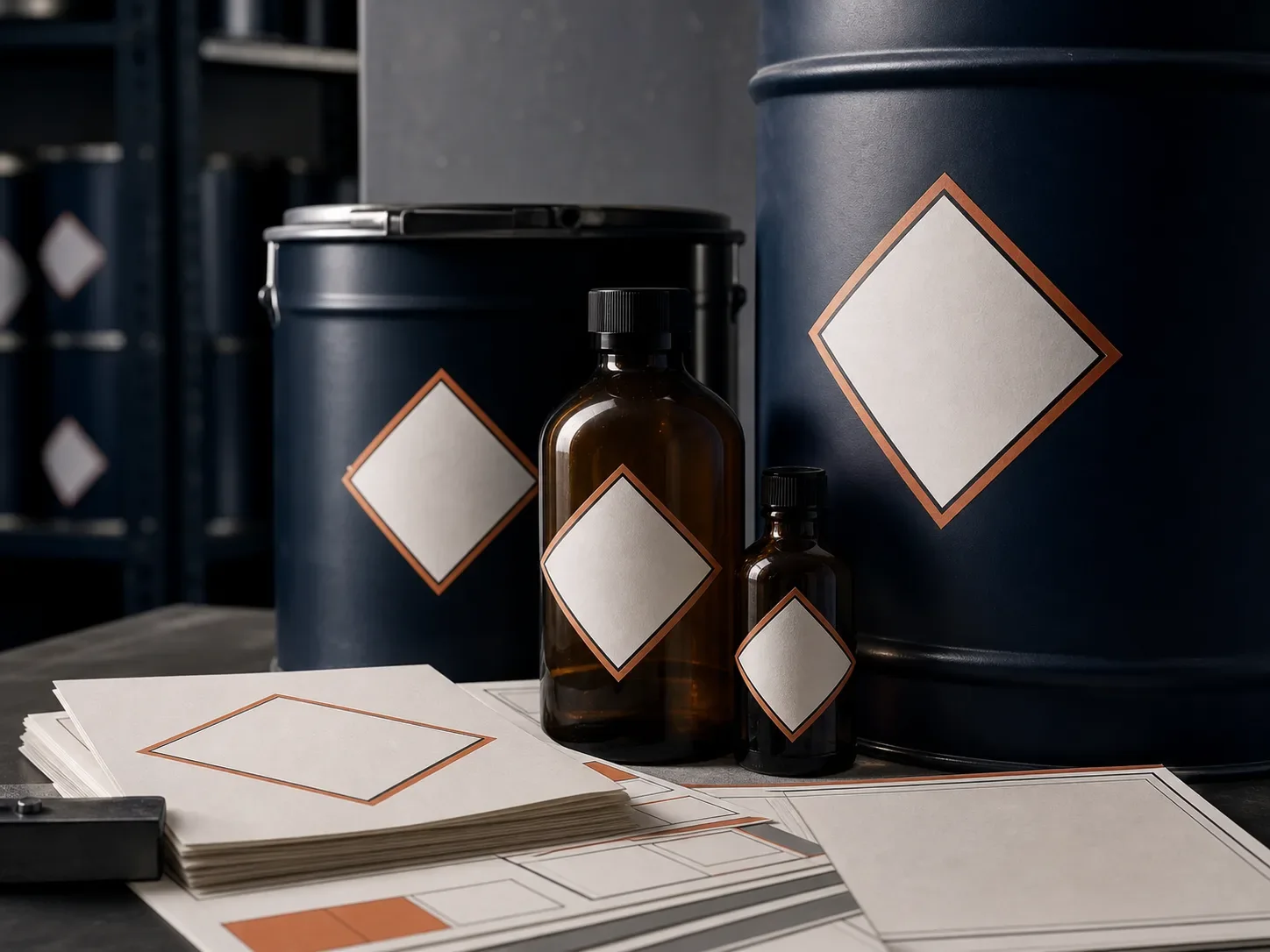
There is one rule in Chinese chemical labelling that changes how a shipment has to be planned, and it is about authorship rather than content: the safety label is applied by the producing enterprise before the goods leave the factory, and an agent or freight forwarder may not add or alter one afterwards.
That closes the escape route people expect to have. In most categories, a labelling defect discovered on arrival is a problem with a cost attached — relabelling under supervision, delay, expense. Here the correction is itself prohibited if the wrong party performs it. What remains is a revised label issued by the manufacturer, applied within whatever the supervising customs office permits, or re-export.
So the label belongs to the pre-shipment file, next to the classification, not to the destination handling plan.
Regulatory basis
- 《危险化学品安全管理条例》 — Regulations on the Safe Management of Hazardous Chemicals, State Council Order No. 591. Article 15 requires producers to affix or attach a chemical safety label matching the contents to the packaging, including outer packages. Article 37 prohibits trading in hazardous chemicals without a safety label. Article 78 sets the penalties, with customs supervising alongside.
- 《化学品安全标签编写规定》 GB 15258-2009 — Rules for the Preparation of Chemical Safety Labels, the mandatory national standard governing content elements, format, dimensions, printing colours and application.
- GACC announcement No. 129 of 2020 — a safety label matching the contents must be submitted at declaration; goods that do not conform are not released.
- 原安监总局第53号令 — the label is a required part of the hazardous chemical registration file.
- 生态环境部《新化学物质环境管理办法》 — Measures on the Environmental Administration of New Chemical Substances, from the Ministry of Ecology and Environment. A new chemical substance imported for the first time needs a safety label carrying environmental risk information.
GB 15258 is technically aligned with the UN GHS, which is what makes cross-border conformity achievable at all. A GHS-conforming label is the right starting point, but alignment is not identity: the Chinese requirements below are the ones that get checked.
What the label has to carry
The standard layout runs:
- Product name, Chinese and English
- Pictograms, arranged by hazard priority
- Signal word — Danger or Warning
- Hazard statements, itemised
- Precautionary statements — prevention, response, storage and disposal
- Supplier information — name, telephone, address
- A reference to the safety data sheet
Two production requirements are easy to miss because they are physical rather than textual. The label carries a black border, with a blank margin outside it. Pictograms are designed for high contrast and adequate size so they remain identifiable at three metres, and in smoke or light contamination. Material must resist abrasion, high and low temperatures, and water — laminated art paper, synthetic paper or waterproof self-adhesive stock. Body text sizes differ between the full label and the simplified label.
Where it goes, by package type
- Drums and bottles — centred on the side, away from the lid, base and the wear areas under handles
- Cases and boxes — on a flat, unsealed end or side panel, at least 5 cm from the edge
- Bags and bales — on a flat area of the front face; flexible packaging may carry a waterproof hang tag instead
- Large tanks — one on each side and one on the front, so the label is visible from several angles
When the goods are both a hazardous chemical and dangerous goods
Products in both regimes carry both labels, and the two have to be coordinated rather than simply both applied:
- Place them on opposite faces, or on the same face with separation between them.
- Where a GHS pictogram duplicates a transport pictogram — flammable liquid appearing on both — delete the duplicate from the GHS label. Two identical diamonds beside each other are treated as redundancy to be removed, not as reinforcement.
Keeping a label current
A label is revised immediately when the composition changes, a new hazard is identified, or the standard is updated — and in any case on a cycle of not more than five years. When it is revised, the SDS and the customs declaration documents are updated with it. This is the point at which labelling stops being a print job and becomes a document control obligation: three artefacts that must continue to agree with each other over time.
Chinese and the official language of the importing country must both appear. For imports into China that means Chinese alongside the source language, not Chinese replacing it.
One end-of-life point worth noting, because it occasionally comes up with returnable containers: a label may only be removed once the container has been thoroughly cleaned and neutralised and the hazard eliminated.
A workable control for an exporter
Three checks, in this order, before the goods are released from the factory:
- Dual-standard review. Check the label against GB 15258 and against the destination or origin regime you also have to satisfy — the EU CLP UFI code, the US GHS 24-hour emergency telephone. These are not interchangeable, and a label built for one will usually be short of something for the other.
- Three-way match. Label, SDS and declaration documents checked against each other, by a named person, before departure. Most rejections are disagreements between these three rather than defects in any one of them.
- A response plan for a mismatch found at examination. The only workable route is the manufacturer issuing a conformity revision, applied within what the supervising customs office allows, or re-export. Knowing that in advance saves the days that would otherwise be spent discovering that the obvious fix is not available.
We prepare and check this documentation with clients before shipment — including drafting the bilingual safety data sheet and the GB 15258 label itself, so the artwork is settled before the packaging is printed rather than argued about after the goods arrive. We attend examination and answer customs’ questions ourselves, and where a mismatch is found at the port we run the correction route above with the manufacturer and the supervising customs office.
What no forwarder may do is alter or over-label a manufacturer’s product on its own initiative. The label is the producer’s statement of what is inside the packaging, and it has to keep coming from them.